It seems obvious.
“Sigur Rós should collaborate with an orchestra,” bassist Georg Hólm states matter-of-factly. “It’s almost as if this was meant to happen a long time ago. But at the same time… we haven’t wanted to do it because we also always thought we wanted to do it in the right way.”
The atmospheric Icelandic post-rockers make songs that float ethereally alongside singer Jón Þór “Jónsi” Birgisson’s exquisite falsetto before crash landing cacophonously, all cymbals and feedback, thrumming low end and furiously bowed guitar strings. Sigur Rós’ emotive ebb and flow—a contrast of delicate beauty and harsh intensity—have been a hallmark of the group’s music for the past three decades.
While Sigur Rós has featured orchestral elements on record and stage over the years (collaborating with the string quartet Amiina, The Okkur Ensemble with three brass and three stringed instruments, and the brass section of Brassgat í bala, who also appear on 2023’s ÁTTA), the three-piece have been touring the globe and playing with 40-plus member local orchestras for the last several years, bringing their intimate but intricate eighth record ÁTTA to life as well as reenvisioning classic songs. A final North American leg takes place this November with the 42-piece Wordless Music Orchestra appearing at all stateside dates.
In 2022, multi-instrumentalist Kjartan Sveinsson returned to the band after nine years away, and the following year, after a decade without a new album, the trio released the appropriately titled ÁTTA (meaning “Eight” in Icelandic), their most orchestral offering to date. In fact, portions of the record were tracked at the legendary Abbey Road Studios with conductor Robert Ames leading the London Contemporary Orchestra on nine of the album’s 10 symphonic songs.
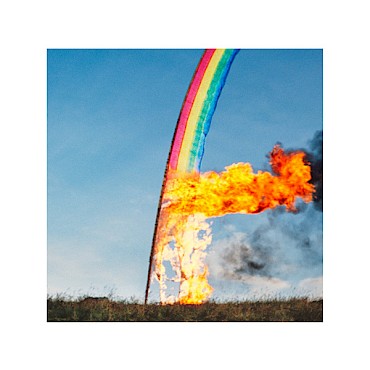 Released on June 16, 2023, the aptly titled 'ÁTTA' (meaning "Eight" in Icelandic) is Sigur Rós' eighth studio album and features the London Contemporary Orchestra on nine of its 10 songs—listen to the entire record below.Reflecting on the creation of ÁTTA, Hólm says, “It was obvious that that record wanted an orchestra.” This is how it’s always been for Sigur Rós when creating new music: Get in the studio and just let the music go wherever it wants to go. Even if the members have had preconceived notions before entering the studio, “usually the ideas just take over anyway, and they just go in the direction they want.
“There were songs on the new record that we did steer towards something completely different, but they always kind of just bounced back. It was like the memory of metal—it just wants to bend back to where it was before.”
“I think that the record naturally wanted to be quite orchestral,” Hólm continues. “Although there were no strings in the original ideas, they just screamed strings. There were some songs that we just thought we could mute what we did and just leave the strings and it would be beautiful.”
That’s not to say that the band didn’t do some experimentation during the recording process. “We did try different things. We put all kinds of beats and drums and things, and it always ended up that we just took them back out and sort of let it just be what it was.” Ultimately, “the record did steer us a little bit,” Hólm shares.
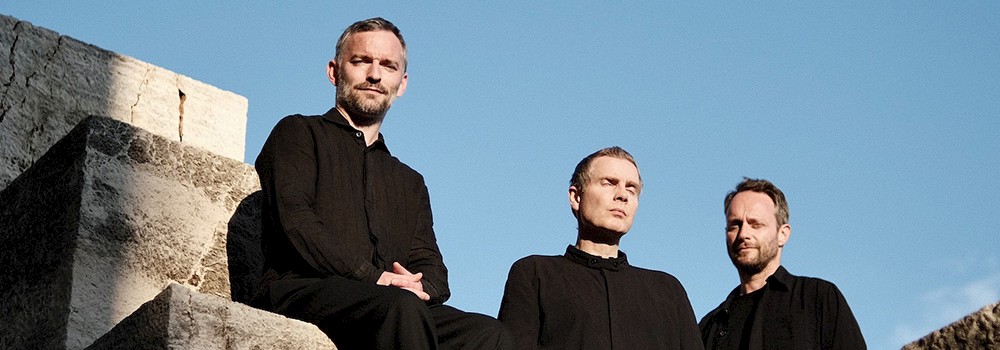
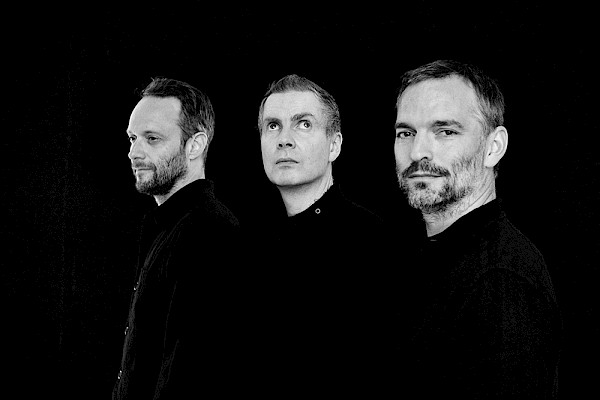 The trio of Sigur Rós—Georg Hólm, Jónsi and Kjartan Sveinsson—are joined by 40-plus member local orchestras led by conductor Robert Ames on the final North American leg of their orchestral world tour this November: Photo by Chloé KritharasTo bring this music to life in concert, Ames and Sveinsson (alongside his wife María Huld Markan Sigfúsdóttir, one of Amiina’s violinists) created arrangements that, depending on the night, feature up to 46 people on stage including Sigur Rós and touring percussionist Ólafur Björn “Óbó” Ólafsson.
It’s a bit mind-boggling for Hólm and the band. “Before this, we were maybe, tops, 12 people on stage. But now we’re between 40 and 50,” he laughs.
That’s a lot of moving pieces every night and something Sigur Rós approaches intentionally. The question was always: “How do we do this our way? How do we do this somehow in a unique way so that it has integrity and is artistic and can stand on its own?” Hólm asks.
The goal was always to integrate the two units: “We are a part of the orchestra,” Hólm says. At shows, the orchestra gets priority placement on stage as each member needs to be able to see the conductor, “and then we can squeeze in,” he says. “It does happen that people can’t maybe see me… but I don’t mind,” he laughs.
The concept serves the music, and it’s allowed Sigur Rós to properly play the songs on ÁTTA while also enabling the band to finally showcase other back-catalog tracks. “We tried to play them, and they never came out correctly. And finally we’re able to play them the way we wanted to,” Hólm explains.
Ágaetis byrjun, the band’s 1999 breakout album, features the stunningly minimalist “Starálfur,” “which we did try back in 2016-17, I think,” Hólm notes. “[We] played it a few times in a completely new version, almost like an electronic version. It never really worked out for us. So it’s quite nice to be able to play a song from a record—and a song that you really love—that you’ve never been able to play properly, and to be able to do it properly now.”
And that’s not to mention new interpretations of older material. “There are songs that we played for years, but we’ve reimagined them,” like “Untitled #5 (Álafoss)” from 2002’s ( )—a 10-minute mosey that ultimately builds to a “quite loud rock and roll sort of ending,” but now “it has become a very, very beautiful orchestral piece that’s probably only like three minutes,” Hólm describes. “It just became a new song, you know, just got a new life.”
Jónsi’s versatile falsetto has always been an iconic component of Sigur Rós’ sound, and in Hólm’s opinion it has only improved with age, maturing to become more full and expansive. “It just has more roundness to it, somehow. More depth, both in sound and emotion. I think he puts more emotion into what he’s doing.”
The band has been recording selections from these orchestral sets around the world, “probably more than I’m aware of,” adds Hólm with a chuckle. This includes video and audio—or “the full experience”—and at some point, they’ll sit down “and decide what we want to do with it.”
After years of additional complexities surrounding touring, the three will do what they do best: Allow the creative process to guide them. “We will probably take a break, regroup and rethink, and maybe come back with something completely different. I really don’t know,” Hólm admits.
Before Sveinsson officially rejoined the band, he took a trip to Los Angeles to visit Jónsi. The pair jammed a bit and made a phone recording. This was the spark that became ÁTTA, and Hólm credits Sveinsson for igniting it: “I don’t think we would have been doing this record without him, that’s for sure.”
When the three got into the studio, “it just felt really natural for us to be making music. And actually, I would say, a relief,” he reveals. “It was a good feeling to be back in the studio making music together, breathing life back into our little project.”
Hólm and Jónsi were 18 and 19 when they started Sigur Rós in Reykjavík in 1994, naming the nascent group (which translates to “victory rose”) after Jónsi’s newborn sister. They are now arguably their country’s most prominent musical export after Björk. After experiencing some initial success, Hólm remembers the band saying, “Let’s continue doing this, and let’s do it as long as we are enjoying it.”
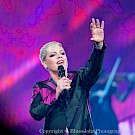
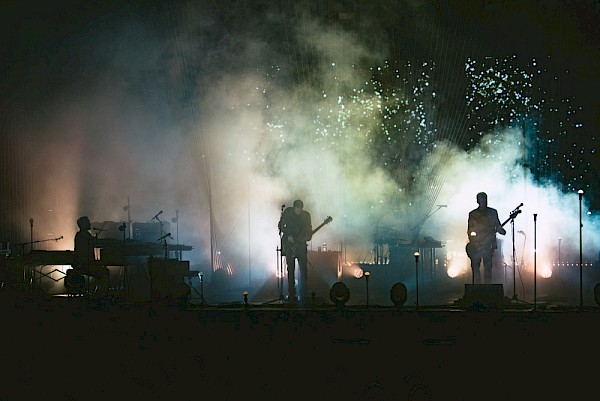 Sigur Rós at the Moda Center’s Theater of the Clouds on May 11, 2022—click to see more photos by Ignacio Quintana“Quite often, we look at each other and go: What’s going on here? We’re just stupid boys from Iceland singing in Icelandic. And there’s like 6,000 people waiting out there to come and see the show,” Hólm reflects. “What a privilege. It’s amazing, absolutely amazing.”
The vast majority of Sigur Rós’ fans do not understand Icelandic (not to mention the invented, non-linguistic vocalizations of Vonlenska, or Hopelandic, that Jónsi employs at times), yet the music elicits extremely powerful—sometimes life-changing—responses from listeners.
“In some ways, it’s proving that music is a universal language. It’s a bit of a cliché, but there’s always a bit of truth to it,” Hólm says. He likes to quote the late Ken Thomas, who produced several of the band’s early records: “Remember that making music is just moving air.”
“It literally is just that. You’re just creating a frequency, it’s just moving air. And people get super emotional, you know? You can’t see it, you can’t touch it, but you get really emotional. It’s quite magical if you think about it that way.”