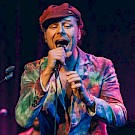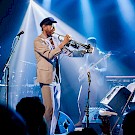
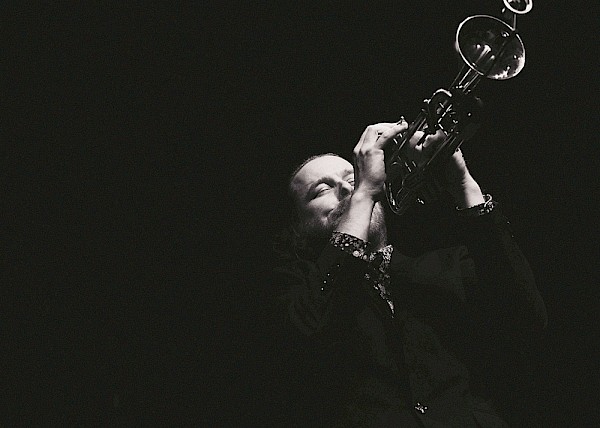
 Lech Wierzynski of The California Honeydrops blows his horn: Photo by Andrew Kelly“You’re talking ancient history here, man,” laughs Lech Wierzynski, responding to a question about the year he moved out to the Bay Area after studying ethnomusicology at Oberlin College in Ohio.
Ancient history by his definition is 20 or so years, but it’s easy to understand why things might be a blur for the dynamic frontman and trumpet player of The California Honeydrops, a retro-soul, brass-filled band steeped in the musical traditions of New Orleans with jug band roots.
For the first decade of the band, he was hustling all the time. “There was like 10 years where we did not do anything, anything, anything else but this band,” Wierzynski emphasizes. “I didn’t go outside. I didn’t go to the park to play basketball. I did not watch TV. I had no life except for trying to do this thing and make it happen.”
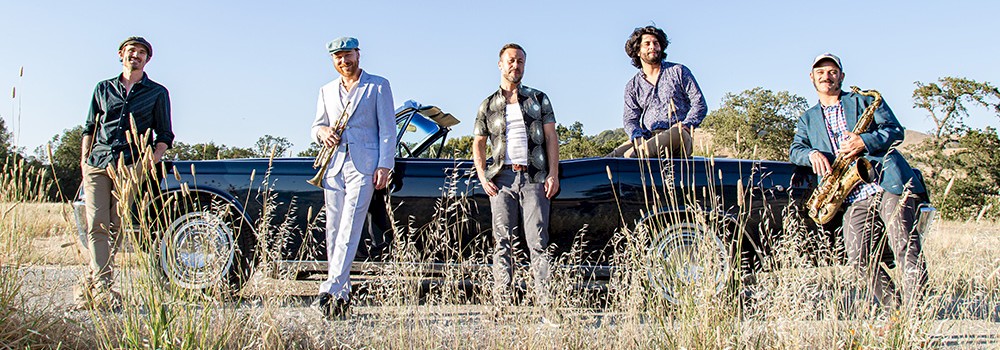
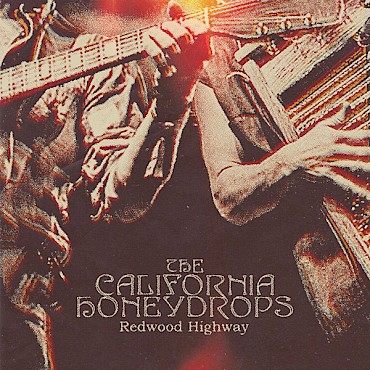 Released on August 8, 2025, the acoustic, stripped-down ‘Redwood Highway’ harkens back to the band’s busking origins—listen to the entire record below.Whether it was roots, ragtime or rhythm and blues, The California Honeydrops spent those early days refining a uniquely eclectic sound that pulls from the past while presenting snappy hooks and horns that resonate today. From busking at Bay Area subway stations in 2007 with founding percussionist Benjamin Malament to becoming festival and fan favorites, the current core of the band has been together for about a dozen years and features Yanos “Johnny Bones” Lustig on saxophone, Lorenzo Loera on keys and guitar, Beaumont Beaullieu on drums, Miles Blackwell on bass, Oliver Tuttle on trombone, Leon Cotter on saxophone and clarinet and Miles Lyons on trombone and sousaphone.
Playing for tips at BART stops provided Wierzynski and the burgeoning Honeydrops with a real-world performing arts education in what works and what doesn’t because, at the end of the day, they were paying their rent with what they earned from busking. They saw what people responded to and leaned into it.
Wierzynski recently dug through a bunch of old stuff in his house “so my memories have been getting stirred all day,” he says. Amongst handwritten signs and old posters from forgotten gigs, he found the original tip jar.
“Just a regular old jar, it had a bunch of hardware in it to fix the tub bass because the tub bass would always break,” he chuckles, listing off utilitarian necessities like a screwdriver and nuts and bolts that came with them on those formative trips. Earning dollars, quarters and dimes was “sustenance” for the first two years.
“We busked a lot actually, because, you know, I wasn’t trying to get a real job,” Wierzynski says, “and I was trying to play music as much as possible.”
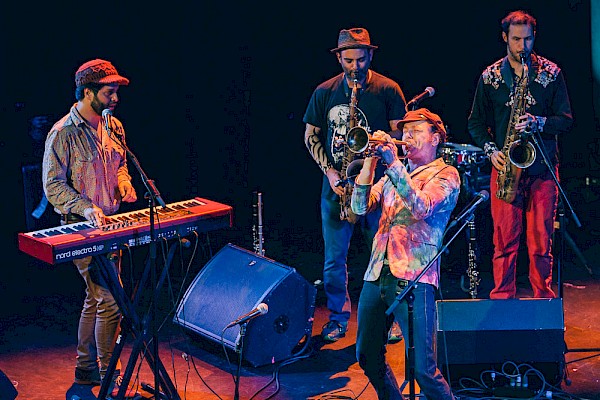 The California Honeydrops live at Revolution Hall on Sept. 29, 2018—click to see more photos by Blake SourisseauWierzynski got his start playing trumpet with some older Oakland blues cats, “where I really learned [and] where I saw and got to play with my first real entertainers and singers.” Some had been doing it for 30 years so it “was a huge educational and influential experience for me,” because the musicians he saw on TV during his youth were “grunge and gangster rap.” He began to base his style more on the Godfather of Soul than MTV.
This flair has been on display on stages with NOLA legends like Dr. John, Allen Toussaint and Rebirth Brass Band as well as alongside blues giants B.B. King and Buddy Guy. Notable admirers include bluegrass forefather Del McCoury, who’s covered a pair of Honeydrops’ tunes, and Bonnie Raitt, who appeared on the title track of 2018’s double album Call It Home and later reinterpreted Wierzynski’s “Here Comes Love.”
“I feel like the highest honor that I’ll ever achieve musically was getting these other folks—who could sing any song they wanted—to sing some of my songs. It’s crazy,” he says.
The impact of old New Orleans music—like jazz and brass bands—on the Honeydrops’ sound can’t be overstated, and many of the band members have links to the music or geographic area. These are sounds they’ve studied, learning the language and idioms of their inspiration.
There’s also a sense they’ve learned the rules so they can break them, bringing their West Coast amalgamation to the mix. “Being an outsider is always kind of good in a way. You get to see things from a different perspective,” Wierzynski says.
Harkening back to those busking roots, the band often slows down the tempo of shows by gathering at the front of the stage for some stripped-down, acoustic offerings, replete with harmonica and washboard accompaniment. Now, this side of the group’s repertoire is captured on tape with Redwood Highway—eight acoustic tunes, released in August, that capture this intimacy on a studio recording.
“This record is a little trip down the scenic side roads of Honeydrops land,” Wierzynski says. “With nothing but the bare essentials, you’re heading up the rugged Northwest coast. A land of emerald streams, dark woods, golden sunsets and cool misty mornings, where the songs roll in on the cold ocean air.”
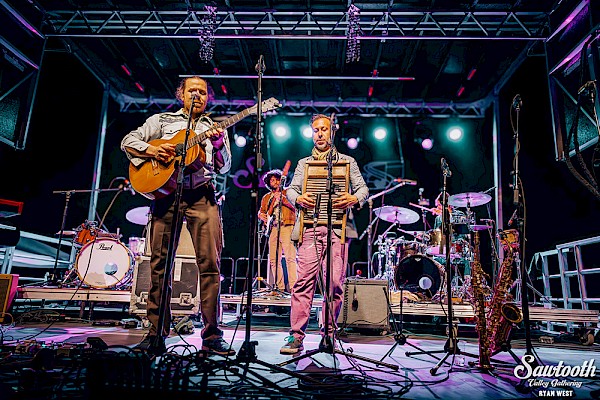 Founding members Lech Wierzynski and Benjamin Malament simplify the set at Sawtooth Valley Gathering in 2024: Photo by Ryan WestSelf-released on Tubtone Records—like everything that’s come before—Wierzynski says the “mellow, acoustic, singer-songwriter” focus revisits the blues and jug band roots of the band, (“There is some tub bass on there,” he chuckles) while also “exploring some new territory. There’s definitely some tunes on there that are not like any Honeydrops thing you’ve ever heard,” specifically the instrumental acoustic guitar track “Feets.”
Longtime fans will appreciate a bare-bones rendition of “Only Home I’ve Ever Known” and the handclap-filled bop “Do It Like That,” which has been a fixture of live sets. Meanwhile, singles “Shine Delight” and “Hold On” are both undeniably the Honeydrops, radiating warmth and heart.
While some of the Honeydrops’ catalogue is suited for dusky lounges, the large group truly shines in sweaty clubs and on open-air stages where their contagious spirit can spread and multiply. The multifarious act has always brought a joie de vivre, never taking itself too seriously and always offering a bit of silliness.
“The band is a little bit wired towards novelty,” Wierzynski says, “and nobody takes that much pride in being perfect.” It’s all about authenticity and “actually enjoying it,” he adds. Back to that concept of taking cues from the audience, the band lives and dies by having no set list at shows.
“Some days it’s just flowing and you know what you wanna play,” Wierzynski describes. “Some days… you ask the crowd what they want to hear, and that’s part of the fun—part of what makes it more of a together experience. And then some days, you’re just lost in the wilderness. You don’t even know what the fuck you’re doing up there,” he laughs. “Some nights, you have higher highs because it’s spontaneous. You’re opening up to the spontaneous nature of life and music and creativity.”
Wierzynski often calls the songs, but sometimes “we discuss it on stage,” he says. “People throw out ideas.”
No matter what, we’re all living in the moment with The California Honeydrops. It’s not preplanned or prerecorded, and “when it’s flowing, it’s this never-ending source of energy and creativity”—for both band and crowd.